5.5 Lab 2 Experiments
Lab #2. LEDs and Transistor Circuits
See section 5.6 Helpful Circuit Analysis of this ebook for important supporting information about these lab exercises. Hands-on lab demos follow each circuit assignment.
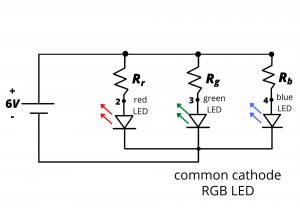
2.1 Build the following circuit using the common cathode RGB LED contained in your kit. Experiment with different colors by connecting & disconnecting the anode terminals of the diodes. It can be helpful to cover the RGB LED with a light diffuser to blend the colors.
2.2 Build the following circuit which creates a detectable infra-red light beam. Detected IR light is indicated with a voltage reading on the multimeter. (Note: The schematic and hands-on videos shown below assume you only have a single 6V battery pack to work with, and therefore the + and – voltage rails of the breadboard on the left are extended to power the breadboard on the right. If you prefer, you can power each breadboard separately since your Fall 2022 kit has two 6V battery packs. Another option is to power one of the breadboards using the USB-to-alligator-clip-leads in your kit. Plug one end into either your laptop’s USB slot or any USB power supply (such as your phone charger) and the alligator clips will give you a 5V power supply. Either of these options will allow you to “untether” the two breadboards, so that they are physically and electrically isolated from one other.)

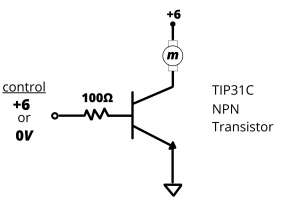
2.3 Build the following circuit which uses a low-side transistor switch to turn your motor on and off depending on the value of a control voltage. You will need to use the TIP31C TIP120 power transistor for this circuit.
2.4 Build the following emitter-follower circuit that controls the speed of your motor based on the light intensity shining on the CDS cell. Use the TIP31C TIP120 power transistor from exercise 2.3. First use an unloaded motor; then connect this circuit to the drive motor of your car if you have it. You should be able to vary the speed of the car by changing light intensity on the CDS cell. (If you don’t have your car chassis yet, skip the second part of this exercise.)