Unit V On-a-Page
Homework
All of the homework for this unit can be found at this link.
Given that this unit is short, so is the homework!
- Only moving charges (i.e. currents) generate and feel magnetic fields
- The field is “real” and the key object (just like for electricity)
- Moving charges make fields which can then exert forces on other moving charges
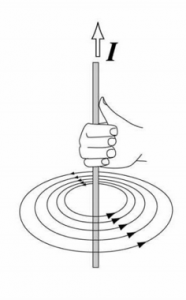
- Use your right hand: thumb in current (
 or
or  ), fingers in
- For the direction of a magnetic field, fingers curl in direction of

 is another universal constant like
  ,
,  ,
,  , and
, and 
- For the force, palm “pushes” in the direction of

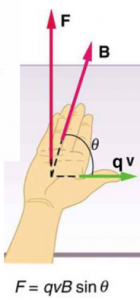
 or
or 
- Result is particles in uniform move in circles!!